Arguing Over Small Things: What’s Behind Recurring Everyday Conflicts
When a couple keeps arguing over dishes, tone of voice, or minor things, it’s rarely just about the specific trigger. This article shows which patterns are behind it, how everyday conflicts arise, and which steps help you get back to being fairer and more connected…

An open yogurt cup in the refrigerator, the mug on the table, an annoyed undertone when asking again: many things couples argue about seem small at first glance. That is exactly why arguments about minor things are often especially unsettling. Anyone who repeatedly rubs up against each other over seemingly insignificant issues quickly wonders whether something is fundamentally wrong with the relationship. The short answer is: not necessarily. Often, such disputes are not proof of a lack of love, but an indication of overlooked needs, unhelpful communication patterns, or ongoing strain in everyday life.
Recurring everyday conflicts rarely have only to do with the dishes, grocery shopping, or the question of who should have thought of something. In small scenes, something larger often becomes palpable: the feeling of not being seen, of being solely responsible, of being constantly criticized, or of having no space for one’s own needs. Those who understand this can read conflicts differently. Then it is no longer only about who is right, but about what is actually being negotiated in the background.
The crucial point is: both perspectives can be understandable. In many relationships, it is not that one person is “too sensitive” and the other “too inconsiderate.” Often, two people are reacting to each other who are under pressure, have different habits, and interpret certain signals very differently. That does not make conflicts harmless, but more explainable. And that is precisely where the opportunity for change lies.
Why arguments about minor things are rarely really minor
Everyday conflicts often ignite around specific triggers, but they are charged by what they mean. If someone gets annoyed about things being left out, it is not only about tidiness. Behind it may be the need for relief, reliability, or respect. Conversely, the other person may experience the complaint not as a factual note, but as devaluation or constant monitoring.
This explains why the same situation repeats itself again and again. The occasion is interchangeable; the underlying feeling remains similar. One person thinks, “I have to take care of everything.” The other thinks, “No matter what I do, it’s never enough.” Both can be true in parallel. That is exactly why factual counterarguments alone often do not solve the problem.
Recurring arguments also develop their own dynamic over time. Anyone who experiences similar conflicts often enough eventually hears not only the current sentence, but the entire backstory at once. A brief comment about a forgotten errand then sounds like a catalogue of accusations. An annoyed look feels like withdrawal or disregard. As a result, the reaction becomes quicker, sharper, and less open to clarification.
Common causes of everyday conflicts in a partnership
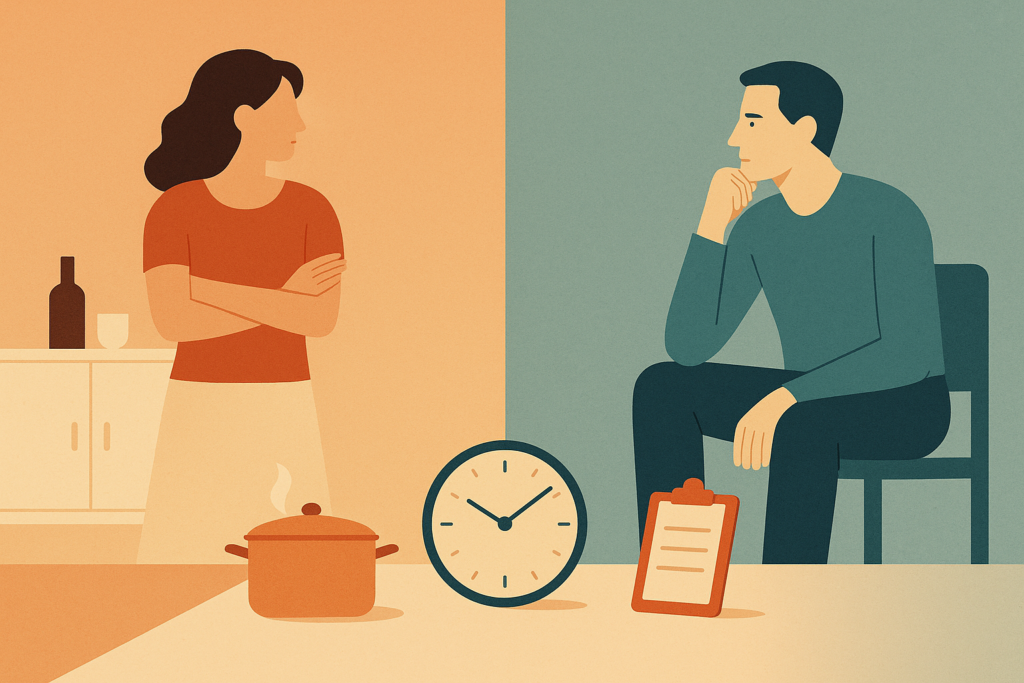
There is no single cause. In most cases, several layers interlock. To understand recurring conflicts, it helps to take a closer look at what is constantly running in the background of everyday life.
Unspoken expectations
Many couples don’t argue about what was agreed, but about what was assumed to be self-evident. If someone thinks the other person should surely notice what is needed, they often articulate the need only once irritation has already built up. The argument then seems to revolve around a forgotten minor thing, but in reality it is about a disappointed expectation.
This becomes particularly delicate when both have different ideas of what care, attention, or anticipating needs actually means. What is a normal everyday routine for one person is experienced by the other as a lack of involvement. Without talking it through, it is easy to get the impression the other doesn’t want to—when more often it is simply: the other sees it differently.
Stress, exhaustion, and irritability
Pressure changes how we listen, speak, and react. If you are tired, under time pressure, or already full internally, you have less room for composure. Then small disruptions feel bigger, and neutral sentences land more sharply. That doesn’t mean stress excuses everything. But it explains why couples experience significantly more friction in demanding phases.
Especially in longer relationships, another factor comes into play: everyday life often consists of organization—work, family, appointments, health, household, caring for relatives. When shared life runs mostly in functional mode, emotional reserves decline. Then the buffer that would otherwise absorb small irritations is often exactly what’s missing.
Different conflict styles
People handle tension in very different ways. Some address what bothers them immediately. Others need time, withdraw first, or hope the situation will settle down on its own. None of these styles is automatically better. It becomes problematic when both misunderstand each other.
Someone who wants to talk right away quickly experiences withdrawal as disinterest. Someone who needs distance first quickly experiences follow-up questions as pressure. This creates a typical pattern: one person pushes for clarification, the other blocks, and both feel misunderstood. Arguing over small things is then often just the visible surface of a recurring communication pattern in the relationship.
Old hurts in the background
Not every current conflict is only about the present. If earlier hurts were never really worked through, people react more sensitively to situations that remind them of them. A curt tone of voice can then touch old experiences of being ignored. A small criticism can feel like a repeat of long-standing nitpicking.
This does not mean that every problem has to be interpreted in depth-psychological terms. But it is worth asking why certain topics in particular escalate regularly. Often it is not only about today, but also about something that has accumulated over time.
How to tell what the argument is really about
If couples want to break out of the pattern, a simple question helps: What does this conflict actually stand for? Not theoretically, but very concretely. What makes the situation so charged? What hurts? What is feared?
Typical underlying themes are:
- lack of appreciation
- the feeling of carrying more than the other person
- too little consideration or initiative
- too much control or correction
- too little calm, closeness, or reliability
- the feeling of not being able to get through with one’s own needs
It helps to shift away from the trigger and toward the experience. Instead of just saying “You never tidy up” or “You always overreact,” it becomes clearer what is happening internally. For example: “When I see that I’m dealing with it alone again, I feel responsible for everything,” or “When you say it like that, I immediately feel judged.” Such sentences do not create a solution yet, but they are more likely to open a conversation than a counterattack.
Why the same conflicts get stuck
Recurring arguments often persist because both sides unintentionally contribute to keeping the pattern stable. This does not mean an equal distribution of responsibility in every individual case. It only means: In stuck conflicts, both usually react in predictable ways, and it is precisely this predictability that keeps the cycle running.
A typical sequence looks like this: One person brings something up, but already irritated. The other feels attacked and defends themselves. As a result, the first feels not taken seriously and becomes more explicit. The second withdraws even further or counters. In the end, both talk about tone, intent, and blame, but no longer about the actual issue.
The more often that happens, the lower the trust becomes that sensitive topics can be handled well. Then even the opening becomes difficult. Some only raise issues in an accusatory tone because otherwise they will not be heard. Others switch off early because they believe they already know how the conversation will end. This creates the impression that you are going around in circles.
What really helps in acute situations

When a conflict is already underway, it is not the best moment for fundamental debates. First, the goal is to stop the escalation without pushing the issue aside. Simple but often underestimated steps can help.
1. Don’t blow up the trigger
Stick to the current point. If, within a few minutes, you jump from the coffee machine to “always,” “never,” and the entire relationship, you overload the conversation. A tight focus is not downplaying—it is a prerequisite for remaining capable of finding a solution at all.
2. Briefly name what is happening right now
Sentences like “I can tell I’m getting sharp right now” or “I immediately feel like I’m on the defensive” can defuse a lot. They name the internal state without directly attacking the other person. That slows the dynamic down.
3. Use pauses deliberately
A pause only helps if it doesn’t come across as a break-off. Better than disappearing without a word is a clear statement: “I need twenty minutes to calm down, then we’ll keep talking.” This preserves commitment.
4. Say the need behind the anger
Anger often shows that something matters. If you can articulate that core, the conversation changes. “You leave everything lying around” can become: “I want not to feel constantly responsible.” That is more specific and less attacking.
Resolving everyday conflicts: practical steps for couples
If you want to defuse recurring everyday conflicts, you don’t need the perfect conversation right away. Often, smaller, reliable changes have a stronger effect than big resolutions. What matters is that both of you talk not only about the problem, but also about routines, responsibilities, and expectations.
Speak more concretely instead of morally
Many conflicts tip over because observations turn into judgments. “You’re inconsiderate” rarely leads to cooperation. “It’s important to me that the kitchen is cleared again in the evening” is more tangible. Concrete language makes change possible; moral labels usually create pushback.
Agree on rules for typical trigger topics
Not every argument has to be fought out from scratch every time. For recurring small issues, clear agreements help. It can seem trivial, but it is often relieving.
- Which tasks are assigned on a fixed basis, which are flexible?
- What counts as important, what as negotiable?
- How do you remind each other without it sounding like control?
- When is a good time for sensitive topics—and when is it not?
Such agreements only work if they are realistic. A plan that is too strict fails quickly and then only provides new material for conflict.
Don’t withdraw goodwill too quickly
In entrenched patterns, behavior is quickly read as intent. Forgetfulness becomes a lack of love, withdrawal becomes indifference, criticism becomes disrespect. Sometimes that’s true, but often it isn’t. Those who cleanly separate behavior and motives are more likely to stay in conversation. It is possible to say, “That hurt me,” while still leaving open whether the other person meant to hurt.
Don’t postpone appreciation to “better” phases
Couples often wait until conflicts have eased before they become friendlier again. Usually it works the other way around. Small signs of recognition don’t fix everything, but they reduce the baseline tension. Those who feel seen are less likely to hear only criticism.
When small things stand in for bigger issues
Some arguments can’t be resolved with better arrangements alone because they point to a deeper imbalance. This can be the case, for example, when one partner consistently carries more responsibility, when emotional closeness has been lost, or when a topic like health, sexuality, family, or financial strain is present but barely discussed.
Then everyday arguments become a vent. The problem isn’t that small things are talked about, but that the real issue can’t be talked about enough. In such situations, it helps to name the pattern explicitly: “I think we’re not just arguing about this one thing. I have the impression there’s more underneath.”
This step takes courage because it brings vulnerability into the room. At the same time, it is often the point at which couples find their way out of endless side issues. Not every relationship needs professional help for that right away. But many benefit when they consciously open the bigger topic in a calm moment instead of only touching it during an argument.
When a conversation outside the argument makes sense
Delicate patterns can rarely be sorted out in the middle of an escalation. That’s why a conversation outside acute situations is often more effective. Not as a crisis meeting with heavy pressure, but as a limited clarification: What are our most frequent triggers? What does each person actually mean by them? What would concretely ease things in everyday life?
A simple structure is helpful here:
- Each person describes a typical situation without accusation.
- Each person says what they feel and fear in such moments.
- Each person names a small, realistic change they would like.
- Both check after one or two weeks what has actually changed.
This matter-of-fact approach is often more effective than long, fundamental discussions. It keeps the topic important without dramatically overloading it.
When outside support can relieve pressure
If arguments over small things become very frequent, escalate quickly, or lead over time to distance, contempt, or withdrawal, outside support can make sense. This also applies if conversations keep breaking off or if old hurts overshadow every new topic.
Couples counseling or therapeutic support is not a sign of failure. It can help identify patterns that are difficult for those involved to see on their own. Especially when both are no longer reacting only to the immediate trigger, but to years of mutual disappointment, a structured setting often brings relief.
What matters, however, is this: support does not replace both partners’ willingness to examine their own contribution to the dynamic. The point is not about who is proven right from the outside, but about how a different way of dealing with each other becomes possible.
Conclusion: Behind small arguments there is often a signal that should be taken seriously
Arguments about minor things are rarely really minor. In most cases, they show that something is falling short in everyday life: relief, appreciation, clear agreements, calm, or the feeling that, as a couple, you are still on the same side. That is uncomfortable, but not hopeless. Precisely because the triggers are everyday ones, there are many ways to change something about them.
The key is not to confuse the surface with the core. Those who only argue about whether the trigger was justified often remain stuck in the pattern. Those who instead ask which need, which hurt, or which overload lies behind it get closer to the real issue. Then a wearing, ongoing conflict does not automatically turn into harmony, but it often becomes a fairer, more understandable, and more human way of dealing with each other.
Couples do not have to learn to never argue again. More helpful is to be triggered less easily, speak more clearly, and recognize sooner what is really going on in the background. That is exactly where change usually begins.
In professional environments, communication patterns also play an important role in relationships when integrations, data flows and further development have to work together cleanly.